
Experience Pain Relief and Ease of Movement in Burnaby.
Fascia Stretch Therapy in Burnaby for Rehabilitation and Athletic Performance.
Level 3 Fascia Stretch Therapy in Burnaby Heights
Where Are We?
Fascia Stretch Therapy™ (FST) is a system of manual myofascial therapy that combines private assisted stretching with soft-tissue release. The Fascia Stretch Therapist works to realign the fascia network and to recenter the joints.
FST sessions are pain-free. They unlock stuck movement patterns that are currently uncomfortable. The breath work and joint traction in Fascia Stretch Therapy sessions also calm the nervous system.
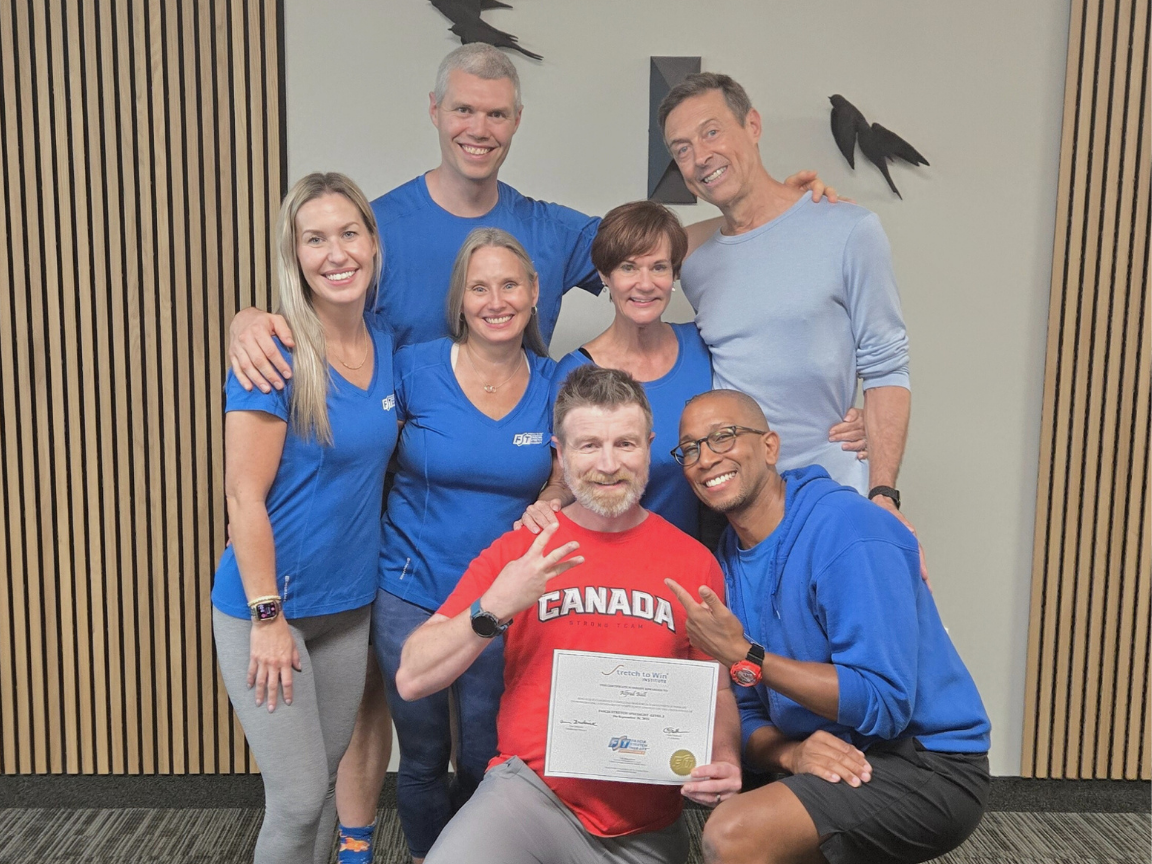
Alfred Ball holding his Level 3 FST certificate while kneeling in front of the STW instructors, in Sept 2025 (image copyright)
Are You Ready to Transform How You Move? Use the Button to Book Online
What Does Research Say About Fascia Stretch Therapy?
While research on FST is limited, it is growing, and there is extensive research on fascia and the scientific principles of Fascia Stretch Therapy. A 2018 study at the University of Limerick standardized 60-minute FST sessions twice per week with athletes, which led to improvements in range of motion of 4-31%.
FAQ About Fascia Stretch Therapy in Burnaby
Static and assisted stretches isolate individual muscles, compress joints, and focus on single directions.
Fascia Stretch Therapy uses traction instead of compression, muscle contraction and relaxation (peripheral neuromuscular activation (PNF)).
FST stretches begin at the joint space outward and move in spiral directions, similar to how we move, to target the entire spiral net.
Static stretching improves flexibility, but not long-term joint motion sense or muscle strength.
A 2021, pilot study on adolescent soccer players compared PNF to static stretching. Both improved flexibility, but PNF improved joint awareness more.
There are many benefits to this form of assisted stretching and myofascial release. Tension is released to create lasting space in the joints, increase strength, and make daily movements less fatiguing.
Other FST benefits clients mention include:
- 1Walking and going up and down stairs with more ease.
- 2Being able to raise their arms above their shoulders to wash their hair or get dressed with less pain.
- 3Waking up feeling more rested because their sleep was less interrupted.
- 4A golf swing that is smoother. Their hips and trunk rotation is looser, so they have more control of the golf ball.
- 5A reduction in headache and migraine intensity.
- 6A sense of relief from arthritis pain. Including functional improvements before and after joint replacement surgery.
A large variety of medical conditions benefit from regular FST sessions.
Clients get pain relief from fibromyalgia, headaches, lower-back pain, and sciatica, among others.
We restore movement in Parkinson’s disease spasticity. Post-stroke clients start walking more easily and move their arms.
For people with frozen shoulders, FST is excellent in helping them regain mobility and strength.
We also see clients for Fascia Stretch Therapy and kinesiology who have complex conditions, as well as for pre- and post-surgery rehab, such as total joint replacements.
Yes, Fascia Stretch Therapy was initially developed for high-performance college and Olympic athletes.
There are now certified practitioners worldwide assisting athletes at all levels, including keeping master's athletes active as they age.
Alfred has kept Canadian Team members playing their sports and has been an integral part of their success.
Yes, Kinesiology-led assisted stretching is covered by many health care benefits providers. It can be billed directly to paramedical or health spending accounts.
Contact your employer and insurance company to confirm. Note: A portion may need to be paid privately due to health insurance limits per visit and the total funding available.
Additionally, FST at Lifemoves is integrated into the ICBC Active Rehab program as part of our treatment plans. This is conveniently directly billed to ICBC, so you can focus on recovery.
Fascia Stretch Therapy sessions are an investment in your long-term health.
They are priced similarly to other allied care providers, like registered massage therapy and physiotherapy.
Effective July 2026, the initial sixty-minute assessment is C$ 145 CAD, including taxes.
This includes a health and movement history review and biomechanical evaluation to understand your range-of-motion limits and set goals. Followed by 40 to 45 minutes of FST treatment.
Prices of follow-up visits vary depending on the length. You can use this link to book online and view current prices.
FST has been around for 30-years. Ann Frederick first developed Fascial Stretch Therapy between 1995 and 1997 while studying biomechanics and human anatomy at university.
College athletes, Olympians, professional athletes, and the general public have been benefiting since then.
Ann and her physiotherapist husband, Chris, teach the four levels of FST to other practitioners at a dedicated space in Arizona, and globally, including Vancouver, Toronto and Calgary.
A few years ago, it was renamed Fascia Stretch Therapy to match their research studies.
Their book Stretch to Win, 2nd edition, explains their technique. It is written with accessible language. The book's content can be understood by anyone without a scientific or kinesiology education.
Are You Ready to Experience the Feeling of Moving Lightly and with More Ease?
❝
After recent abdominal surgery, I resumed Fascia Stretch Therapy once I was mobile. Over the past 3 months, FST helped me regain mobility in my hips and core. Enabling me to start rebuilding some core strength. I’ve found Fascia Stretch Therapy to be a fantastic method to help my muscles, tendons and ligaments to start working properly again.
CLAIRE
MasTERS Cyclist and Runner
What Happens During Each Fascia Stretch Therapy Session in Burnaby?
- 1During the first appointment, we complete a comprehensive assessment. is completed during the first appointment. We review the online health intake forms. We listen to your movement goals, movement history and health history. Afterward, we move to the treatment table for the Fascia Stretch Therapy (PNF-assisted stretching).
- 2We complete mini-assessments and check-ins at the start of every follow-up visit.
- 3You receive clear instructions before and during each FST session.
- 4We review the exercises, stretches, and the treatment plan.
- 5We try to book the follow-up visits on-site.
- 6You will have space and time to ask clarifying questions throughout and at the end.

What is Fascia and How is Its Health Important to Wellbeing?
Fascia is a communicative and dynamic tissue that surrounds are bones, vascular system, muscles, nerves, joint capsules and internal organs.
Changes to the fascia cause major and minor imbalances in strength, speed, flexibility, balance and agility. Usually, the cause goes undetected until an injury or major stiffness causes pain.
What Changes the Structure of Fascia?
Age, trauma, injuries, poor posture and inadequate training will distort, twist and tighten fascia. This can cause pain and discomfort in joints, muscles, tendons, ligaments and discs.
Most allied health professionals use static stretching that does not stretch and align the fascia from the joint capsule to the muscles. Stretching along the fascial line achieves a greater range of motion.
❝
Flexibility is optimal adaptability. Flexibility is a perpetual state of readiness. This is the rapid ability of a person to recruit the necessary amount of physical, mental and emotional strength to complete the activity. It is developing the correct amount of speed, agility, stability, balance and mobility to meet a sudden or sustained demand. Then rapidly and completely recover when that demand is removed.”
Chris Frederick
Founder StretCH WIN and Co-Developer of FASCIA STRETCH THerapy
Watch the Videos to Hear Directly How Fascial Stretching Helped These Clients
Sven Winter is a retired Team Canada Ski Cross athlete. Hear why he kept booking Fascial Stretch Therapy to stay active.
Kandice sought FST to help her regain hip mobility to return to kickboxing.
Are You Ready to Make Everday Movement Easier?
Which Medical Conditions Benefit from Regular FST?
People who live with a variety of long-term health conditions experience symptom improvement with regular Fascia Stretch Therapy™. This is because it reduces passive muscle tension, restoring movement and reducing pain associated with their disabilities or diseases.
FST™ enables people to return to activities after an injury. They return to enjoying golfing, tennis, gardening, cycling, curling, and downhill skiing. and more. Fascia Stretch Therapy helps people stay active, and reduce injuries. It also enables them to manage chronic pain as they age.
Is Fascial Stretch Therapy for Athletes?
Yes! Fascia Stretch Therapy was first developed to help college and professional athletes recover from the rigorous demands of high-performance training and competition.
Alfred's kinesiology and assisted stretching skills have empowered many Canadian National Team athletes and weekend warriors to return to their sports and stay there.
Read what figure skating Olympian Liam Firus and others say about their experiences with Fascia Stretch Therapy.
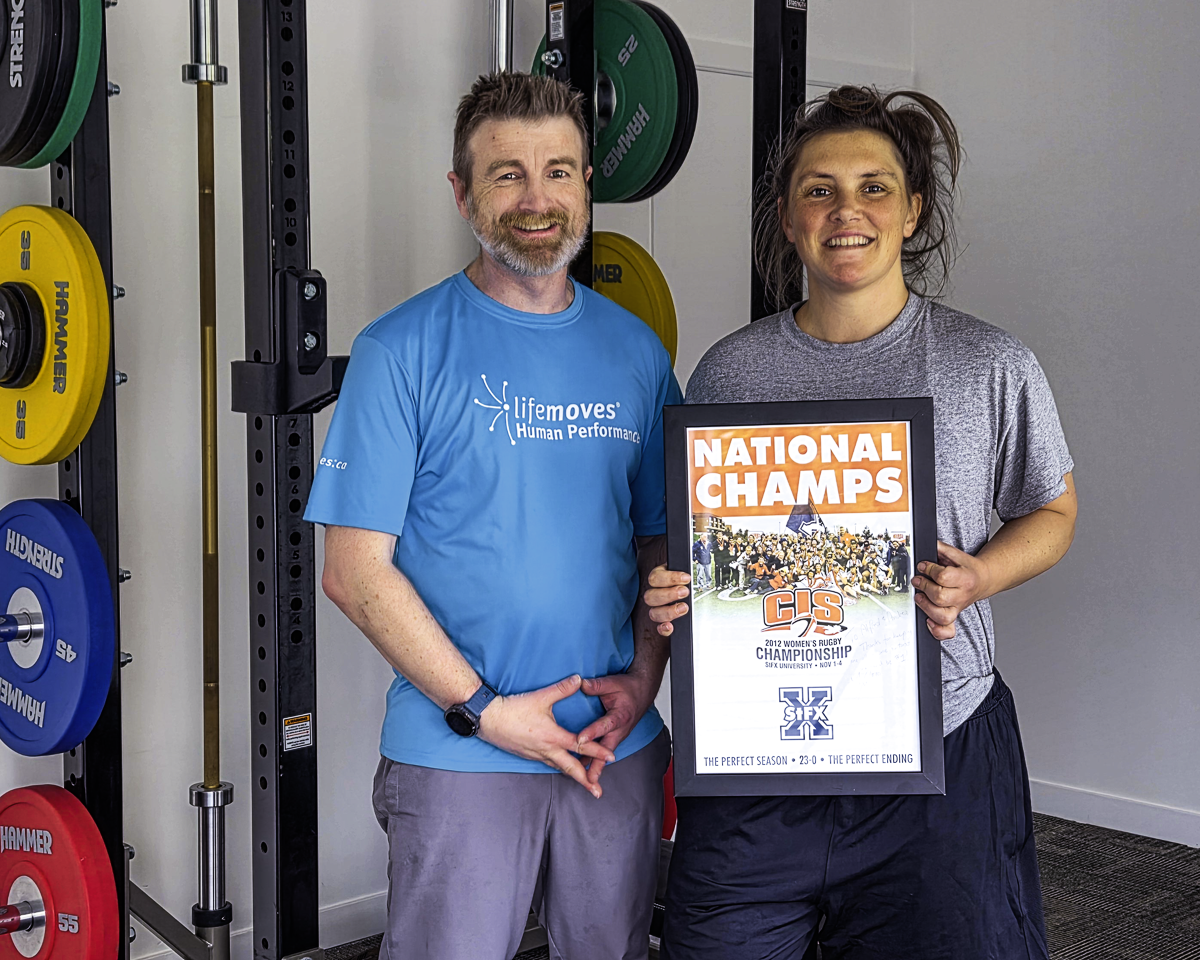
Retired Team Canada Women's Rugby member and CIS Champion Beth McNeil with Alfred Ball, Level 3 FST in Burnaby, 2026 (image is copyright by Lifemoves)
Are You Ready to Move with More Speed, Power and Freedom in Your Sport?
How Alfred Became a Level 3 Fascia Stretch Therapist

Alfred Ball met Ann and Chris while at a fitness conference in 2007. He was looking for a method to assist a client with Parkinson's disease to gain more mobility.
That spring, he travelled to Arizona to train in FST. After the training, he became one of the first three health professionals in British Columbia to provide Fascia Stretch Therapy. He is a Level II Certified Fascia Stretch Therapist.
In September 2025, he travelled to Ontario to successfully complete the five-day intensive Level 3 Fascia Stretch Therapy certification. It was in person and led by Ann and Chris Frederick, with assistance from a group of talented teachers.


