
How to Stay Strong to Prevent Fractures from Osteoporosis
Have you been told you have osteoporosis? You’re definitely not alone! Osteoporosis Canada recently released statistics showing that 1 in 3 Canadian women and 1 in 5 Canadian men will break a bone at some point in their life because of osteoporosis. Also, most alarming is that osteoporosis is more common than heart attack, stroke and breast cancer combined! (1)
There isn't a cure for osteoporosis however, an appropriate EXERCISE program is part of osteoporosis treatment. A Practicing Kinesiologist, can help you improve your back extension strength, hip and leg strength, bone strength and manage your osteoporosis so that you can live without fear of falling or fracturing your bones.
The medical term for "strength of bones" is called Bone Mineral Density (BMD). Research shows that BMD decreases naturally by 1-2% and 2-4% for males and females respectively, so it is great news that we can slow these rates down by completing the recommended exercise. But what is recommended?
What Are Strength Training and Exercise Recommendations for People with Osteoporosis?
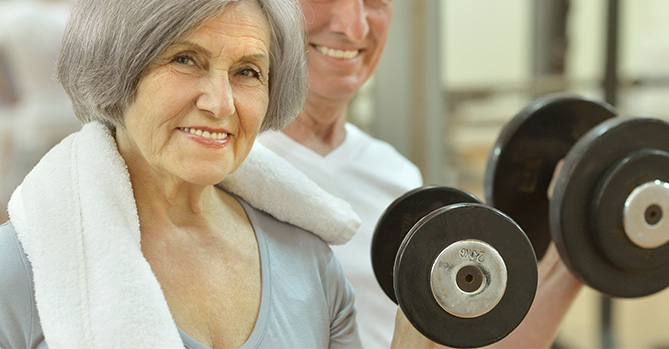
It is great to see that strength training is now a component of exercise that has been proven to be beneficial for osteoporosis treatment. Strength training involves using a form of resistance, such as body weight or an external resistance, to create tension in your muscles, which loads the bones and therefore slows the reduction of BMD. Resistance training also increases muscular strength and improves balance (1,2,3).
Strength training now important part of #osteoporosis exercise programs!
Osteoporosis Canada and researchers at the University of Waterloo developed a program called “Too Fit to Fracture” to help individuals manage their osteoporosis through EXERCISE! There are tips on what exercises you should perform, possible barriers to exercise you may experience, exercise progressions, how to keep track of your progress, and which movements are not recommended because doing them puts you at a higher risk for fracture.
There are also some very good video guides that give examples of how to modify activities like golf so that you can continue to enjoy them. The videos show people with various severities of osteoporosis. Exercise recommendations include aerobic training, strength training for the upper and lower body, and balance and posture training.
Cardiovascular exercises like swimming and cycling are good for the heart, but are not weight-bearing. Walking, running, stair climbing, and hiking are all good examples of weight-bearing aerobic activities that can increase your BMD.
Home Strength Exercises for Osteoporosis Treatment and to Prevent Falls
Now that we know the benefits of exercise for osteoporosis, why not get started today? Here are some exercises that can help if you have osteoporosis. These have also been prescribed in the Osteoporosis "Too Fit to Fracture" Canadian program.
They are simple enough for beginners, as well as for those with more severe osteoporosis who are more fragile. These are starting points with guided progressions.
5 Beginner Home Strength and Balance Exercises for Osteoporosis
A Kinesiologist will coach you to safely complete these exercises and guide you toward more challenging levels. The three main goals of an exercise program for osteoporosis are:
- 1Increasing muscle mass and strength to protect your bones.
- 2Providing you with challenging balance exercises that improve your coordination and reduce your risk of falling.
- 3Increase muscular endurance, especially of the back postural muscles. This lowers your risk of spine compression fractures.
1. Walking or Stair Climbing
- Complete most days of the week for 30 minutes at a moderate intensity of 5-8/10 intensity.
- If 30 minutes seems too much at once, remember you can break up the activity into two lots of 15 minute bursts throughout the day.
Tip: With walking, remember heel-to-toe movement. Keep your chest high and lift your feet off the floor. When stair climbing, hold onto the rail if you are unsteady. For variety, do 15 minutes of stair walking and 15 minutes of walking!
2. Squats or Sit-t-Stands for Leg Strength
- Complete 2-3 days per week for 8-12 repetitions
- To complete a squat, stand upright, keep your weight through your heels, stick your bottom out backwards and hinge your upper body forward, keeping knees behind the toes.
- Practice by sitting on a chair and standing up (sit-to-stand). Progress from the chair to standing, then add mass as you feel you are getting the movement right. You can hug the mass to your chest.
Tip: You can use a 1kg bag of flour, soup cans, or hand weights to increase the difficulty as you gain strength.
3. Split Squats for Balance and Knee Muscle Endurance
- Complete 2-3 days per week for 8-12 repetitions
- Stand in a split stance, one foot in front of the other about hip-width apart. To complete a lunge, drop the back knee close to the floor, so that your front knee is at a 90-degree angle. Only go as low as comfortable.
Tip: Hold onto a bench for balance if needed
4. Inclined Wall or Counter Push-Ups for Arm Endurance
Complete 2-3 days per week for 8-12 repetitions- Place your hands on the wall at shoulder height and at shoulder-width apart. Keep your chest upright, shoulders back and lower your chest into the wall while bending your elbows.
- Keeping controlled, push yourself back to upright without locking your elbows.
- Tip: Start by completing wall push-ups, then once this gets too easy, move your feet further away from the wall, progress to a push-up on your knees and then onto your toes.
5. Single Leg Balance
- Stand upright, hold your shoulders back and keep your head up tall during all balance exercises so that you are working on your posture
- Complete these exercises daily
- Toe Tapping: Holding onto a bench for balance, alternate your left and right foot in the following sequence; forwards, backwards and sideways.
- Single Leg Balance: Holding onto a bench for balance, lift your left foot 6 inches off the floor and repeat with your right foot.
References
- Osteoporosis Canada. Osteoporosis Facts and Statistics.http://www.osteoporosis.ca/osteoporosis-and-you/osteoporosis-facts-and-statistics/. Accessed February 9, 2016
- Raastad, T., Kvernvik, KJ., Johansen, M.A., Running, A., Dullerud, R., Kvamme, N., Solberg, P and Gautvik, K.M. (2015) Marked Improvement in Physical Function through Gains in Muscle Strength and Thigh Muscle Size after Heavy Load Strength Training in Women with Established Postmenopausal Osteoporosis. Journal of Osteoporosis and Physical Activity 3:136.
- Layne, J.E., Nelson, M.E., (1999). The effects of progressive resistance training on bone density: a review. Medicine and Science in Sports and Exercise 31(1):25-30.
Last Updated on 3 months by Alfred Ball


